
A Repeatable Process For Solving Problems Quickly In Your Coaching Business

I added a digital product to our offer lineup back in April and since then, I’ve become extremely good at solving problems.
Today, I’m going to show you how I think about them…
Because it’ll work to help you solve your problems too.
And it’s so simple to start - all you’ll need is a notebook, and a pen.
NOT your computer, phone, or laptop.
Coaches don't need more followers. You need better marketing to the ones already watching. Follower to Client delivers weekly insights, paired with proven frameworks, swipes and templates from inside the fitness coaching businesses we write for so you can convert your warm audience… without cold outreach, ad spend, or going viral.
Let me show you the most recent example of a problem I solved:
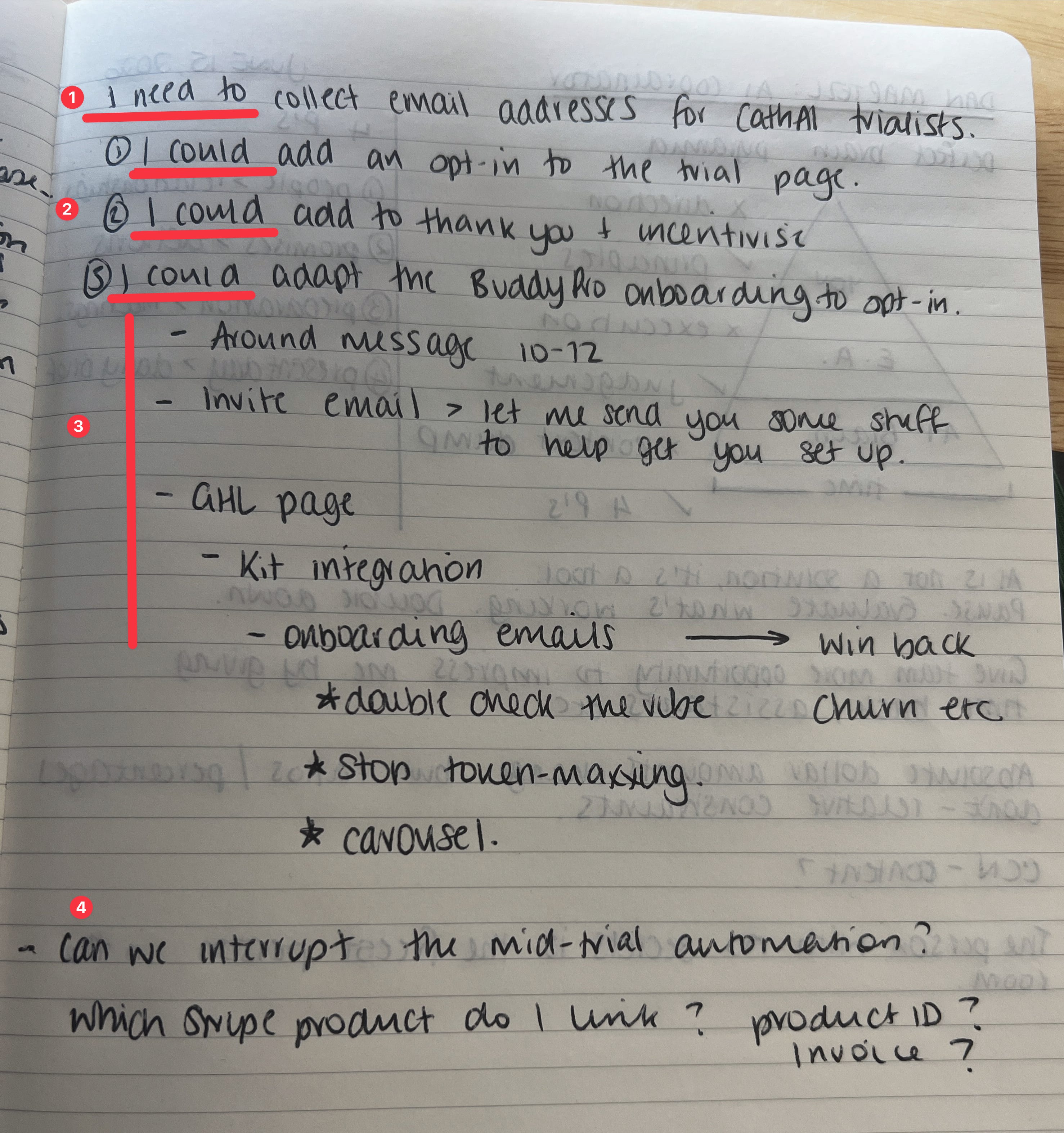
PART 1: Name the problem
We use an opt-in trial.
Meaning: CathAI doesn’t need anyone to give their email address, phone number, or card details to start a trial.
This is a problem because…
I can’t welcome anyone
I don’t know who’s trying us out
I can’t help anyone if they get stuck
I can’t make them an offer if they don’t choose to buy
I can’t upsell or downsell them anything, or customise their experience outside the app
…You might think:
This is shit.
Just make them give you their card details first.
But CathAI is great, and I wanted to remove friction for people to try it out.
We’re optimising for trial starts.
I just wish I had their email, so that I could send them some resources to make money quickly.
Here’s how to write about it:
Your opening sentence starts with…
“I need to…”
Say it as plain as you can.
In this early version of this practice, I noted that solving ONE problem would sometimes solve a whole bunch of others - if you picked the right problem:
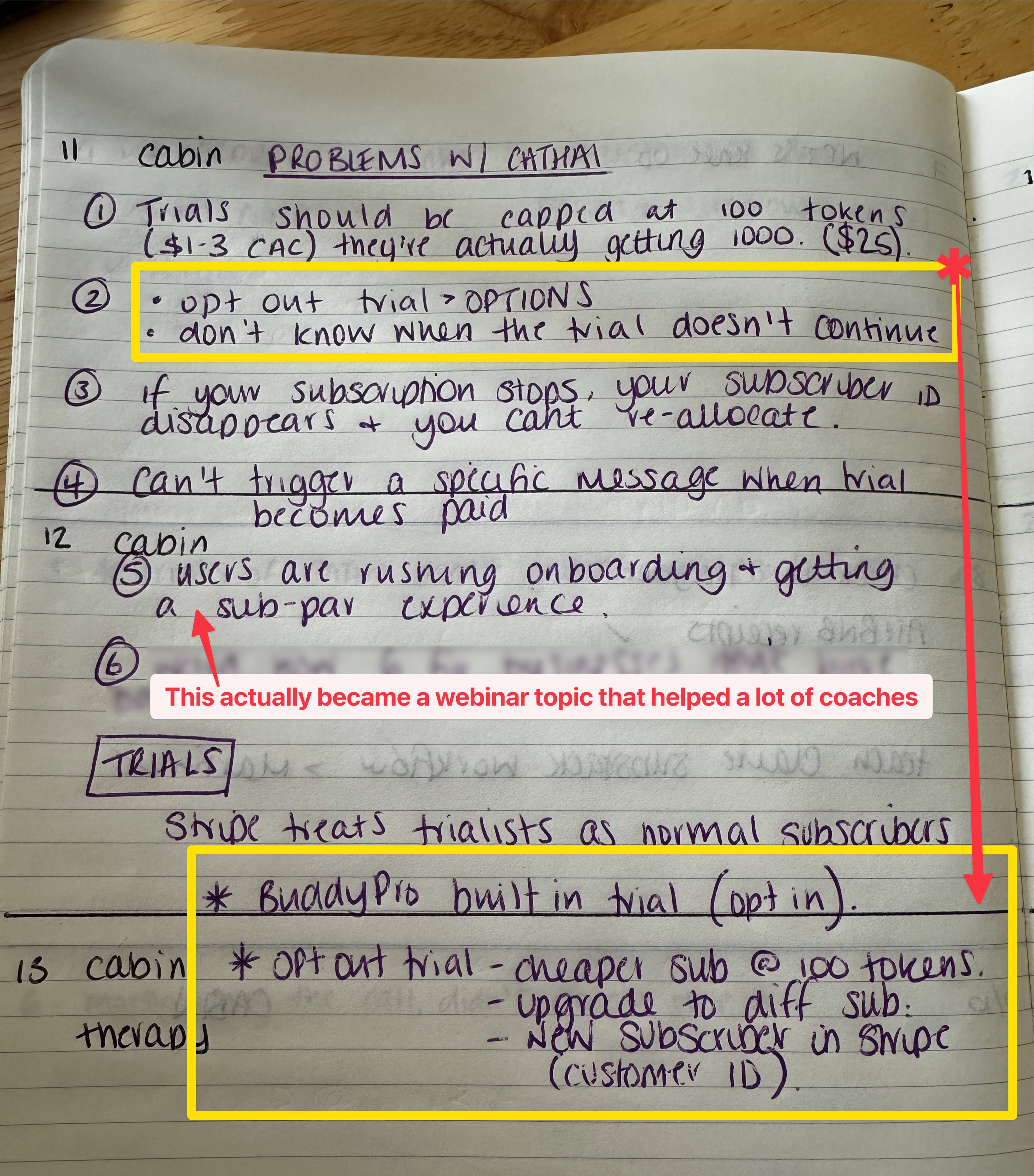
For coaches, that might look like…
“I need to find a way to help clients with alcohol during the summer.”
PART 2: Braindump some solutions
The goal here isn’t to pick THE solution.
Just write down what you’ve considered doing.
Everything you’ve considered. The goal is volume.
ALL the ways you could solve this problem.
I like to start these sentences to show the possibility, not to make any commitments (I don’t know, it just helps me be creative).
Start these sentences with:
“I could…”
And write as many as you can think of.
PART 3: Pick one and outline the steps involved
Sometimes (in fact, a lot of the time) you won’t know which idea is best. It won’t be obvious at all.
So you might want to write a little pro’s and con’s list next to each sentence.
If that happens, you’ll want to remember what you’re optimising for.
For example:
Don’t get caught up in getting good data if the goal is revenue.
I find it really hard to know what order to do things in…
So I list out all the “parts” I need in place…
And then figure out what order to make them in afterwards (I often get this part wrong for some reason).
For example, I’ll try to update the source documentation before the emails are written - stuff like that.
PART 4: Note any on-going questions
You don’t always know the questions and open loops until you start making stuff.
I reckon if you did, it would stop you from ever getting started.
So I like to keep a running list of “how-do-I’s” at the bottom.
I come back to them later, when I understand more about the process IF they’re important.
Bonus:
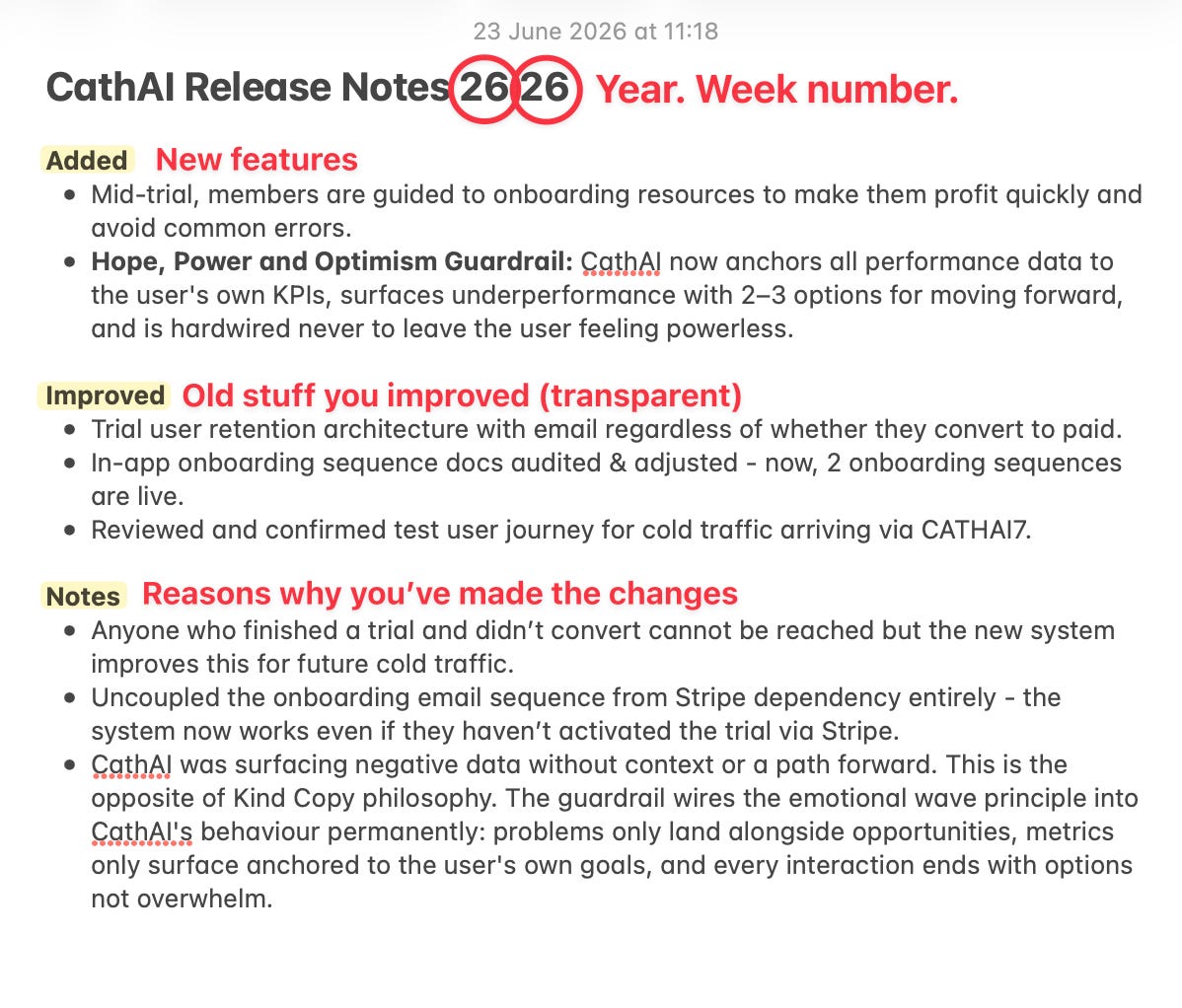
Every week, make a release log.
Everything you’ve done, and learned that week.
All the problems you solved.
For coaches - this could look like changes you make to your approach for check-ins during the summer (“we’re switching to a voicenote check-in, so you spend less time at your computer and more time on your walk while it’s sunny!”)
Apart from being a great piece of content that shows how committed you are to an excellent product…
It also reminds you of the scale of the problems you’ve overcome and helps you build confidence in your abilities.
Boom!
That’s it.
That’s the process I’ve used as a non-technical person to solve all the tech issues I’ve faced since having an AI product.
If you want to check out CathAI - you can read more here.
Or if you just want to follow along for the behind the scenes, come follow me on Instagram. I’m very transparent about everything I’m learning.